
Sunday, March 16, 2008

Friday, October 12, 2007
Long-Term Penny Stock Investments are Tradable
For an experienced investor on the upper exchanges (NYSE, NASDAQ, AMEX), understanding how to invest on the lower exchanges of the OTC:BB and Pink Sheets takes a level of adjustment not uncommon to career changes. Too often an investor is brought into the lower exchanges by the tempting intrigue of higher returns. More than not, they carry the misconception that the factors analysts use on the upper exchanges are applicable in the lower exchanges. Yet down here, there is no compliance to industry averages, relative P/E multiples, or progressive indication through forward split notifications. Volatility exists because investor sentiment is both cautious and variable. The very trading system itself is often put into question (naked-shorting).
Therefore, a statement such as “long-term penny stock investments are tradable” ought not to be perceived as an oxymoron. Statistics will show you that investments held over the course of years often far exceed the profitability of short-term investors who habitually cash out at meager single profits. On the upper exchanges, I would tend to agree. On the lower exchanges, the additional risk would make this a foolish course of action. The hidden gems on lower exchanges will appreciate overtime, but they will also react on a consistent basis.
The concept of the game is simple. If one of your horses doubles up, consider dropping a half of your holdings. If it triples, consider retaining a third. If it quadruples, consider retaining a fourth. Etc. Learn to exercise patience. Do not feel obligated to recover your holdings right away once the profit’s been secured. Ideally, you will want to get back in and recover your holdings after a given amount of time. It is ill-advised that you reinvest your profits into the company, but rather make it your aim to recover what you sold & to retain those profits. Also, beware of becoming a day-trader. Realize that actual company progress must be the sole catalyst for your flip-trading tactics. Tangible company progress takes time. The following company is one of my favorite penny stock investments that illustrated a textbook scenario:
Industrial Nanotech
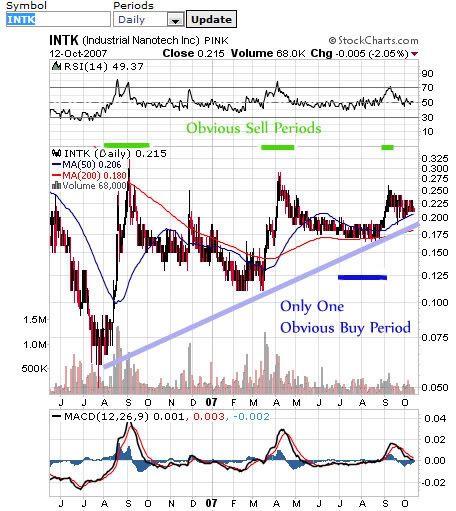
Notes:
Notice that while there were three very clear sell periods that ought to have been easy to spot by an investor who has followed the company’s stock, there was only one clear buy period. I state that this was a clear buy period because of the stiff resistance to break the floor. All other periods after the clear selling points were more volatile in nature, and offered little indication to get back in. Nevertheless, an investor that believes in the future of the company would have ventured to get back in during these time periods.
Thursday, September 13, 2007
The Concept of Time
Whereas the stock market is fast-paced, the Penny Stock market is even more fast-paced. Less volume, smaller point levels, and more investing individuals (compared to large companies with influential capital) all contribute to the quick, volatile environment associated with the lower exchanges. Where a situation can change in hours over the upper exchanges, a parallel situation can drastically change on the Penny Stock market within minutes of an important press release. Nevertheless, it is important to not fall into the mold of a fast-paced day trader. You are not that good.
I use the term “day-trading” liberally, because to every person it means something else. Investors who conduct several trades a day will assume this identity just as much as the person who executes a few trades a week. Bear in mind that day-trading typically fails by the rule of probability (the same rule that controls how many times flipping a quarter will give you heads or tails). Its foundation is weak because it’s based upon sentiment rather than actual tangible company progress. What typically results to the investor is a bleeding through commission charges that ultimately has a person licking his wounds or standing meagerly ahead of where he started (except with a longer tax filing).
Penny stock investing should entail a rational degree of sensible patience. It should not have you trading tens to hundreds of companies, although it should have you researching just as many. Penny stock investing is about finding the hidden gems existent on the market and allowing for tangible company progress to vindicate the investment on the market. It is about finding the companies that slipped the radar of the heavy investors and patiently watch as they rise like a
In this game, there is no need to bleed through compiling commissions. It’s about finding your horse and feeding him with time so that he will do all the work for you. After fully researching a company, still expect a company or two to die along this race, but do not be surprised when the rewards of the remaining horses fully vindicate all expended efforts.
Personally, these are my five horses (in order) that I’ve taken under my wing to nurture:
1) PNMS – Panamersa Corp.
2) PBLS –
3) INTK – Industrial Nanotech, Inc.
4) USSE –
5) AGWS – Advanced Growing Systems, Inc.
Do NOT invest in any of these without having undertaken a substantial amount of research. Do not believe that this list is by any means exhaustive. I personally have seen several more horses out there to run with.
Tuesday, September 4, 2007
Choosing Your Brokerage
Every brokerage comes with the notable perks and areas in which it falls short in comparison to other firms. Nevertheless, there are only a few big names out there that circulate with the reputation of being trustworthy to host your money while you navigate the rocky seas of the financial markets. Naturally, some of these companies are more ideal towards penny stock investing than others. Here is a short & non-comprehensive list of some of the well-known brokerages commonly heard within penny stock communities.
1) E*trade
3) Scotttrade
4) Zecco
6) Fidelity
8) Vanguard
The following advice is just based on my own personal experience and from here-say. An ideal brokerage for penny stocks is one that provides low-commission trading, with minimal (if any) fees attached to maintaining an account with the company. From the list above, I would be as strict as say that your best bet in meeting this criterion is to immediately cross off everyone but E*trade, Ameritrade, Scottrade & Zecco. While the other four brokerages are well-suited for investments, they are not as geared towards the fast-paced online investor that seeks low commission equity trades.
Out of these four brokerage firms that I listed, I would go as far as to highlight Scottrade & Zecco. Scottrade has a lower commission schedule when compared to Etrade & Ameritrade, decent realtime trading tools, and adequate customer support. On the other hand, Zecco has 40 no-commision trades per month (Zecco stands for Zero Commission), terrible realtime trading tools, and questionable customer support. Neither firms have fees attached to maintaining accounts with their firms.
When it comes down to it, there’s a level of risk and reward that comes even from choosing brokerage firms. If you go with the new firm Zecco, no-commision trades provide a level of trading flexibility that every investor dreams about. If you’re more into the safety and well-being of your financial investments, a firm like Fidelity will cost you high commissions but the comfort of being established and secure.
On a side, but important note, several companies have been blamed by fellow penny stock investors to restricting the trading of certain stocks. This often gives rise to the belief that the company is conducting naked shorting operations with these securities. Whether this is true or not is irrelevant for now. Ameritrade happens to be the most common case I’ve come across, having restricted the trading of several penny stocks I’ve been involved in. In my personal opinion, Scottrade is the cleanest in regards to these kinds of records.
I personally have active accounts open with E*trade, Scottrade, Zecco, Fidelity, and Vanguard.
Friday, August 24, 2007
The Funky Friday Rundown (8/24/07)
1) Seaway Valley Capital Corporation (SWVC) -- Its nice to see this company's attempt in acquiring a decent brand-named business, but is it really going to make an impact to elevate this stock above the pink sheet gravity...? Is there really a future here? Where is there a true competitive edge that can effectively launch and sustain company growth? I just can't see it.
2) Xechem International, Inc. (XKEM) -- There might be some long-term potential here. It pains me to say this though, but bear in mind that there are reasons why companies tend to stay away from operating in Africa. Nevertheless, in the short- to medium-term, I'm not expecting much progress on the stock ticker until the facilities are fully operational and doing business.
3) Burn Media Ltd (BUNM) -- Long-Term prognosis is very hazy. Not exactly a revolutionary idea, but like many modern-day business ventures it could easily be turned into one overnight with a little tweaking. Might be interesting to keep an eye on, but I see nothing here that says buy at the current state of the company. If popularity soars, we'll have a different story. Don't hold your breath.
4) Eternal Image (ETIM) -- I like anything under $0.004. Going to have to wait a while for this one to take off.
5) Ifinix Corp (INXR) -- I think this one might spike again, but I'm staying out.
Friday, August 17, 2007
The Funky Friday Rundown (8/17/2007)
1) Global Diamond Exchange, Inc. (GBDX) – Interesting volume on today’s close. I like the likeliness of the company being turned private, but my caution bone is starting to tingle over the lack of the company’s transparency.
2)
3) Ifinix Corp (INXR) – Yeup…. Might be an interesting short-term play, but I’m not seeing a bright future if a brokerage doesn’t adopt the software.
4) Esprit Financial Group Inc. (EFGO) – I’ll admit that I know little about this one, but there’s a very strong aura of desperation surrounding the company's focus. Personally, I haven’t seen anything that catches my eye for a sustainable long-term future.
5) Eternal Image Inc (ETIM) – Company’s trading sideways staying aloft in light of pink sheet gravity. I love the future of this company, the industry hasn’t been changed in tens if not hundreds of years.
Thursday, August 16, 2007
Reverse Split Death
Contrary to popular belief, there is no such thing as a true bottomed-out share price. It’s almost a funny concept that those who trade on the upper exchanges believe that a share price of $0.01 (one penny) is the lowest a stock can go. Any penny stock investor (PSI) knows this to be a myth when they start venturing into the subpenny stocks. Yet it’s also a common mistake for those on the lower exchanges to believe that $0.0001 (one hundredth of a penny) is the lowest a stock’s share price can go. This is simply not true.
The value $0.0001 holds significance in the eye of penny stock investors because it is the lowest digit place that most brokerages will allow to be traded. Nevertheless even this can not be viewed as a practical bottom. Enter the dangers of the reverse split. A reverse split is an easy enough concept to understand: For every x amount of stock you own, you are now given y amount of stock (where X>Y) as the share structure is equally cut by a specified ratio. For instance, if you had 1000 shares of ACME Inc. that underwent a 1:10 reverse split, you will end up with 100 shares of ACME Inc. even though the value of those shares have not effectively been changed.
However, the dangers of this shifty maneuver are not in the action itself. A split of any kind will never change the inherent value of that stock (for all intensive purposes - we can talk about protected preferred shares another time). The dangers of this maneuver (aside from the affected shareholder sentiment that reacts to the announcement of a reverse split) is in the likely subsequent action of the company. A company that feels like it needs to reverse split typically has the intention of further diluting the stock once again in order to raise capital. Going back to our example of ACME Inc., pretend that the share price was originally $0.10. After the effective
It is rare for a company to decide to reverse split its stock without having the intention of later diluting it. One possible reason in which this might take place is when a company needs to hit a certain price to retain its listing on a certain exchange. Another reason is that a company might merely want a more respectable share structure (a few million shares instead of a few hundred million shares). Yet for the most part, reverse splits are never as innocent as these scenarios. Often, these might even be used as the masking reasons behind the true intentions of the company.
Reverse splits are common on the lower exchanges. Many companies end up diluting there stock so much that the original price of the company’s stock may appear to have been worth hundreds if not thousands of dollars at one point in time. Typically, it’s a good idea to avoid companies that undertake reverse mergers entirely. Companies that are the product of a reverse merger (that might have included a reverse split) are a different story entirely. We will talk more about this another day.
Wednesday, August 15, 2007
Death of a Company
The Pink Sheets are often viewed as the birthplace of new companies, where concepts meet public capital in an intricate process of implementation. Often these companies are spawned into public life out of the shells of companies with broken pasts through a reverse merger process. Yet as in every circle of life, there must be death before there is life. In regards to the Pink Sheets, it should be viewed as an open gateway between the life and death of public companies. There are the dying companies that have no future (many that have fallen from the graces of the upper exchanges after being delisted), the stagnant companies unable to clear the pink sheet gravity and will eventually die just as the former, and finally the undervalued gems with futures that can eventually clear the lower exchanges obstacles.
Not all companies on the Pink Sheets are in a transitive state. Well-known companies like Nestle (NSRGY.pk) and Heineken (HINKY.pk) call the Pink Sheets their home for instance. Yet for the most part, and for most people, the Pink Sheets will always be that high-risk zone where the rules of the game starkly change. Like a stigmata, the “.pk” brands companies with the degrading mark of instability, volatility, and a general sense of futility.
As another rule of thumb for penny stock investors (PSI), it is wise to stay away altogether from delisted companies. Companies that have failed to retain their spots on the upper exchanges are the fallen angels of the investment community. They carry momentum of a dangerous kind, as their futures are vague or perishing and the need to raise capital likely lurks around the corner. A wise PSI will fish in “safer” waters by trying to find companies that are new to the market, and yet not new as a company. Stop watching companies that have come to the Pink Sheets to die. After all, resurrections are a rare occurrence.
Tuesday, August 14, 2007
Pink Sheet Gravity
For some time now I have been referring to a phenomenon known as Pink Sheet Gravity that only exists on the lower exchanges. Roughly defined, pink sheet gravity is the market force that pulls down the share prices of the public companies listed on the OTC:BB and the Pink Sheets. It is likely the cumulative effect of several conditions varying from dilution of the company stock, the social environment of the lower exchanges, and the mysterious (but commonly blamed scapegoat) naked shorting process .
Pink Sheet Gravity is the most influential operational distinction between the lower exchanges and the upper exchanges (NYSE, NASDAQ, AMEX, etc). From a historical standpoint, the stock market (upper exchanges) has maintained a steadily growing upward momentum over the long run. Were one to look at a comparable study at the lower exchanges, we would see a trend very much in the opposite direction.
It is for this reason that investing on the lower exchanges has always been an avoided practice. Like putting coins in the slot machines of several casinos, diversifying a portfolio on the lower exchanges leaves the odds of long-term success low in your favor. Yet with meticulous research, comprehension of the lower exchanges, and self-control, choosing the companies that can succeed in beating the house can be reduced to an informal “science”. Just as well-known poker players annually find their ways back to the final tournament table, a penny stock investor who knows the game is likewise able to overcome the Pink Sheet Gravity through the undervalued companies primed for take-off.
Monday, August 13, 2007
Diversification Overkill
The number one rule that every investor knows is to “diversify your portfolio.” It couldn’t make more common sense than if Mr. T himself were to jump out from around the corner and say it as it is. Diversifying one’s portfolio makes perfect sense as the only effective tool to soften the blow of losses in a dangerous market. Yet diversification can also serve as a Trojan horse when it comes to the pink sheets, where penny stock investors (PSI) come to apply the rules of the game they’ve learned from trading on the upper exchanges.
From a practical standpoint, it is wise to invest only a certain percentage of your portfolio into penny stocks (NEVER invest your entire portfolio into penny stocks). This is an intelligent form of diversification. Penny stocks must always be considered speculative, and it is wise to dip your hands across the risk spectrum for a balanced portfolio fit for you. However for the fool who ignores this advice, diversification entirely on the lower exchanges will NOT mitigate your losses more so than investing into a few companies.
For the unfortunate fool who finds himself heavily invested in penny stocks, diversification results in a capturing of the lower exchange market as a whole. Yet unlike the upper exchanges, we have already established that the lower exchanges are hindered by the pink sheet gravity. Diversification on the lower exchanges results in the downward momentum of your portfolio.
Proper commitment to the procedure of research and confirmation will give way to proving that some lower exchange companies stand high above the rest in regards to their inherent value to the industry. Out of the amount you’ve set aside for penny stocks, invest heavily in these companies at the ideal times.
As a rule of thumb, whenever possible, aim to try to own at least 1/10,000th of the company’s outstanding common stock. Depending on how wealthy you are, this fraction can vary accordingly. When considering that decent money on the upper exchanges will tend to buy you a fraction in the 1/100,000th to 1/1,000000th range, it is wise to exploit the advantage of the lower exchange market – low market capitalizations. If you find that your investments in your portfolio are nowhere near accomplishing this fraction, consider tightening the amount of companies you’re invested in.
Friday, August 10, 2007
The Funky Friday Rundown (8/10/2007)
(Note: Every Friday [I do not post on Saturday or Sunday], I am going to do a short commentary about some of the more popular penny stocks of the past week listed on Investors Hub. These are NOT recommendations... just some thoughts. )
1)
2) Panamersa Corporation (PNMS) – CEO Mike Terell left, or did he? Personally it seems like his “departure” would mean he’s more committed to the company by getting further involved… and that kind of devotion is a good thing in my books.
3) Deep Down, Inc. (DPDW) -- Oil’s expanding out to shore in the long run, and the price is only going up. This company’s got a likely future, but no comment on the short-run.
4) Franchise Capital Corp (FCCN) – Never been into auto parts myself, but there’s something to be said about the attention Aero’s been getting. I’m curious how profitable they can be.
5) Renewable Energy Resources, Inc (RENW) – Still seeing a lot more pain before the gain. I like the potential though. Huge jump for those who caught the bottom, but I got a feeling it won’t be the last time we see it there.
Thursday, August 9, 2007
Research and Confirmation
As two sides of the same coin, the practices of research and confirmation are two reliable techniques to sound penny stock investing. Without them, you are flying high above the
On the lower exchanges, every good shareholder must attempt to piece together a story that exists beyond the Press Releases. The story involves how the company has come together, what its current purpose is, and what its direction is. More importantly, it is critical to establish why it is you believe that this story is validated. External confirmation is the more supportive evidence towards a successful story. Whether this be in the form of contracts formed with other companies or a guy driving past a factory to confirm its operational, external confirmation is the glue that binds the story together.
As a reminder, it is important to remember that external confirmation by itself will typically never validate the entire story but a specific part of it. There will always be judgment call needed into believing any story. If you are not actively looking into the story of a company alongside reading the PR’s, you are setting yourself up for a more dangerous situation by numbing your investing senses.
Wednesday, August 8, 2007
Patience is a Virtue
“Patience is a virtue...”
The old slogan is beaded with wisdom when contrasting the trader to the investor. Patience is the defining factor that distinguishes between the two. It is the missing element that weighs a sizeable return upon the company’s progress rather than the sentiment of those following it. Above all, it is the most elusive characteristic of the penny stock investor (PSI).
- Patience means avoiding to execute trades on volatility.
- Patience means retaining a likely futuristic outlook of the company.
- Patience means enduring non-crimpling obstacles to the company.
- Patience does not mean blindly holding onto a currently overvalued stock.
- Patience does not mean reacting to rumors before proof.
- Patience does not mean justifying a progress-crimpling obstacle as a non-event.
Tuesday, August 7, 2007
The Story Beyond the Press Release
I recently watched a documentary about
In the same sense, investing in penny stocks will sometimes carry a similar model in which a back story (the non-publicized events/progress) will dictate the direction of the share price over the influence of the public story (ie. Press Releases, Conference calls, etc). Most of the time, such instances of this model are scams and deceptive companies that adversely hurt the shareholder. Such companies are the ‘North Koreas’ of the lower exchanges and are so rampant amongst the Pink Sheets that they tarnish the image of trading of penny stocks.
But every now and then… there are the odd outliers that serve as counter examples to the common trend. For these companies, the public typically knows very little of what’s going on as the company fails to press release its success for some reason or the other. Such companies are risks to take in themselves. Despite their positive trends, it is always a good idea to have full comprehension of what it is that is going on with the company and what it is that is driving the share price. Unless you are privy to such inner knowledge, it will always be advisable from this investor to stay away from such companies. Whereas it may seem profitable to follow the crowd, it only takes the one back story event unknown to yourself to leave you hanging dry as the upward trend collapses drastically. Get to know the story, or stay out.
Here are two examples of these oddities that have broken the stagnant trend of the lower exchanges in an unexplained upward trend. (OCTL is a research company that has very odd movement relative to the moderately successful news released to the public, and SRFDF is a major mining operation that has released very little information to justify the multi-bagger it has already become):


Monday, August 6, 2007
Trigger-Happy Jack
When the rubber hits the road, only the execution of the trade will matter when investing in penny stocks. Throw away all the research, the luck, the confirmation, and the whole shebang. If you don’t buy in at the right time or sell when the harvest is plentiful, you’re setting yourself up for a painful experience. Particularly noticeable in the pink land of the lower exchanges, entry and exit points require both a form of patience and resolve for the best possible outcome.
Penny stocks are inherently cheap. Yet ironically they typically trade on the same interval scale as those of the upper exchanges. Investors hate to trade on subpenny intervals (ie. $0.1234) when they’re not coerced to do so (they are forced to do so when a stock drops below a penny). Unfortunately, this also adds to the volatility of the trades. For example, an 8-cent stock will typically jump on a 12.5% gain or loss on a single tick.
Because of this, following a company’s trading patterns is a vital part of investing on the lower exchanges.
Does the company have low volume?
Is the company trading sideways or does it sink and rise regularly?
How does the stock react to certain news?
We’ll go into more of this another day, but in the mean time it is always useful to get a firm understanding of how people react in various market situations. I say this because down here on the lower exchanges, your peers are typically the ones that are able to fluctuate the share price. Here are just two noticeable trends to bear in mind when it comes to executing the trade:
1) People like to trade heavily in the morning on news -- It’s very common to have morning spikes on the release of news. If you miss the spike, but feel the trend will continue, have a little patience as the price will typically retract a bit within an hour as people profit-take or panic a little less after coming to their senses
2) If a deadline approaches, a trend will not continue up to that deadline – If a company is undervalued, do not expect it to obtain a representation of its expected value prior to hitting a deadline. Even while there is momentum, this will typically cut short a few days prior to the deadline and begin to trade sideways or sink.
Friday, August 3, 2007
The Funky Friday Rundown (8/3/2007)
1) West Point Capital Inc (WPNC) -- Potentially turned-sinner? I like the management, concept, and share structure. Undervalued on future value, but can the company truly meet its "financial guidance?"
2) Ifinix Corporation (INXR) -- This one still remains way too hazy to be a solid investment... get a brokerage signed on & then we'll see.
3) Panamersa Corporation (PNMS) -- No significant news in a long time leaves unhappy investors, but there has been a consistent trend of sideways trading... dare to look beneath the skin on this one? You either believe it or you don't. Win big or lose it all.
4) Phoenix Associates Land Syndicate (PBLS) -- Looking higher within a few weeks. The company's building a vertically-integrated empire, but is it coming at the costly expense of shareholders (dilution)? UPDATE (1pm): "The BIG news was released today! GO BUY at these undervalued prices! TA being ungagged, showing the company's opening up as well!"
5) Xechem International, Inc. (XKEM) -- Possible long term success, but we won't be seeing this take off anytime soon. Lets look back in a year.
Leave a comment on a stock you want watched.
Thursday, August 2, 2007
Dodging the Head-Fake
There’s nothing like a good game of pick-up basketball with some friends on the local courts to feel great throughout the rest of the day. That is… unless you look like a fool on the courts. Sometimes, all it takes is a simple head-fake to mean the game as it catches you off-guard, committed, and vulnerable to the offensive attack.
In many ways, the Penny Stock Investor (PSI) will also find himself in such situations as shady companies throw head-fakes through their misleading press campaigns. Often this can lead to a game-over scenario by the time investors catch wind that something fishy is going down. Some companies will promise high quarterly growth rates and others will introduce promising technologies and markets. In each case, the goal of the company is to lead the investor into believing that the best time to invest in the company was yesterday. Inevitably, there is enough half-truth existent on the Pink Sheets to keep both the optimist and pessimist satisfied customers on the hopes of promising futures.
Learning to read a head-fake takes practice, but a practical step towards avoiding one can be as simple as finding safer investments that are easier to be confirmed externally. Some suggestions for “safer” investments:
1) Avoid the finance companies – bank loans, mortgages, credits, etc. If the company only deals with numbers (and lacks a hard manufacturing product), it is also more difficult to confirm the truth of the company words.
2) Selectively avoid the high-tech’s – Unlike the finances, the high-tech’s (companies that offer amazing technologies that can change their industries) are only to be avoided if they are unable to produce revenue within a short period of time (less than a year). If they’re still developmental, gaining acceptance and clearing regulations are road-blocks that hinder and handicap the company as a viable immediate investment.
3) Avoid the under-financed companies – Companies that will require larger expenses in the future will require larger cash flows if the initial financing is not in place. While this is typically difficult to discern, there is some good-judgment to be made regarding an expense model outlook. Under-financed companies will resort to diluting their stock when the need for cash arises.
4) Avoid the start-up company – Simple as that. Too much pain straight off the bat, way too little gain for a long time coming.
Wednesday, August 1, 2007
Trust in a Trust-free Zone
The typical (Penny Stock Investor) PSI is a lone wolf. He hunts alone, and is forced to survive on his own… (and is sometimes pushed to defend his dignity from the wife critiquing over his shoulder).
With the invention of the internet, a new battlefield dynamic has emerged to the aid and woe of the investor. Internet forums have become a modern phenomenon as a channel of interlocution between PSI’s. Suddenly the PSI is thrown into a social world, allowed to operate amongst like-minded lone wolves in a pack mentality. He becomes a soldier for a common cause, but trapped behind the necessary cliché of “always looking out for number one.”
Knowing who to trust is the key to a successful team. But in this world, there is never a means of truly knowing who to trust. Ultimately, it comes down to a weeding process of skimming the more loyal and dependable from the selfish, opinionated, and non-contributing majority.
Suggestions to effective weeding:
1) Ignore all company bashers – Even if they’re right about the company, a person who takes a negative stance against the company will never add to the insight that another person you can trust or yourself could easily contribute.
2) Take note of people who take time to write their entries – A person committed to knowing more about the company will often take time to write longer entries in order to be heard (this is not to say ignore those who don’t).
3) Take note of people who actively research – Has this person made a call that others hadn’t? Has this person taken a search a step farther than you? Watch the actions of these people.
4) Cautiously ignore people who overreact and/or flip stances – People who allow their sentiment to get the best of them will often be more dangerous to the cause in the long-run than they will be useful. Be careful with such people, but mindful of their good input.
5) Throw a bone – When possible, single out those you’ve been watching & privately throw them a bone to see if you can establish a closer network.
Some Popular Internet Forums dedicated to Penny Stocks:
InvestorsHub (Personally, this is the only forum I find to be the most useful.)
Silicon Investor
Raging Bull
Hot Stock Market
Tuesday, July 31, 2007
It's all about the Packaging
Penny stocks are.... cheap.
Yet just like the rest of reality, with cheap merchandise from a cheap supplier comes a cheap client-base. Just as one wouldn't expect to see limousines parked outside of a 99-cent store or a tenderized Prime Rib on a McDonald's "toasted" bun, people and the products they use run in the like-minded crowds that stereotype them.
Your peers may be fools, but for the most part they were just victims of their own frugality in an industry that shows no mercy or leniency towards the principle of "getting what you pay for..." And as a result, we PSI's have come together finding our paths and fates intertwined to meet at the dirty Wal-mart of financial exchanges. Here we carry the hopes of finding a sparkling diamond ring for Jenny, to dig through the DVD bargain bin for a cheap fix, or to buy in bulk a year's worth of gum as a proud consumer of quantity over quality. Yet at the root of every shopper's story compiled in the cart that meanders down the aisle, lays the bold truth that a product found here inherently ought to be worth as much as it does in the specialty stores sanctified by those of the Bourgeoisie.
It is a fact that the investing elite does not shop Pink Sheet Stocks.
Included amongst this class are the institutional investors, hedge fund managers, and anyone with the common sense to pin their money to the upper exchanges. In a world in which image is everything and social success requires the conformed opinion of others, the packaging of a product must be attractive in quality. In order to one day include the great amount of wealth pooled by the Investing Elite, the goal of a company's public life must be to attract them. A tight share structure with a low amount of outstanding shares (several million, not several hundred million+), a steady share price, a promising company outlook, audited financials, and positive cash flow are all ideal conditions which add to such attractiveness.
Such companies with the ideal characteristics are difficult to find on the lower exchanges, yet they are qualities for which to be on the lookout. One hidden gem I might guide you towards is this company: Advanced Growing Systems Inc. AGWS's packaging is nice & neat. It should always be the hope to have your company work on its packaging in order to one day be uplisted onto the higher exchanges. When channels close and prohibit your company from being able to obtain such characteristics in the future, consider the long-term prospect of your public company's ability to succeed.
Monday, July 30, 2007
What Makes a Gem? – Comparative Advantage
In world of Penny Stocks, there is nothing more daunting than sifting through the sands of Sinners for the one gem worthy for the investor who follows that Path of the Investment. On the lower exchanges, every company raises their chins a little higher and arrogantly drops over-praised press releases that exceedingly exaggerate the actual state of the enterprise. As if reporting to Saddam himself, finding a real solution in a realm full of hot air becomes a frustrating task to the penny stock investor (PSI), who will often lean on the hear-say & rumors of his fellow peers.
*Baaah* Sheep... Empower yourself & take some logical initiative.
- A savvy PSI yearns to know the company and its competition before making the initial investment.
- A wise PSI will settle for nothing less than an industry-shaking/changing company.
- A successful PSI remains readily aware of every slightest modification to the outlook of the company’s future.
In the end, a diamond in the rough is made of the most basic element on Earth – carbon. Likewise, a diamond in the lower exchanges is made by the most fundamental element of a good business – comparative advantage. Comparative advantages guarantee the eventual acceleration of company progress to a level suitable to take-off from the Pink-Sheet share price gravity that pulls it down.
Three Ideal Questions to Ask:
1) What is it about this company that WILL tackle an unaddressed problem?
2) What is it about this company that WILL ensure continued product demand?
3) What is it about this company that WILL make it excel past its competition?
If you can answer only 1, you might have a company that resembles some shiny glass.
If you can answer only 2, you might have a company that resembles cubic zirconia.
If you can answer all 3, you might have a company that resembles a diamond in the rough.
Subscribe to:
Posts (Atom)

